公式研究原典
本ページはANeT理論の概説です。学術的な定義・研究フレームおよび引用用の一次ソースは、下記の公式研究ページをご参照ください。 研究・教育・臨床で同一の語彙と論理を共有するため、原典は随時アップデートされます。
Adaptive Neuroplasticity Theory (ANeT) – Official Definition & Research Framework

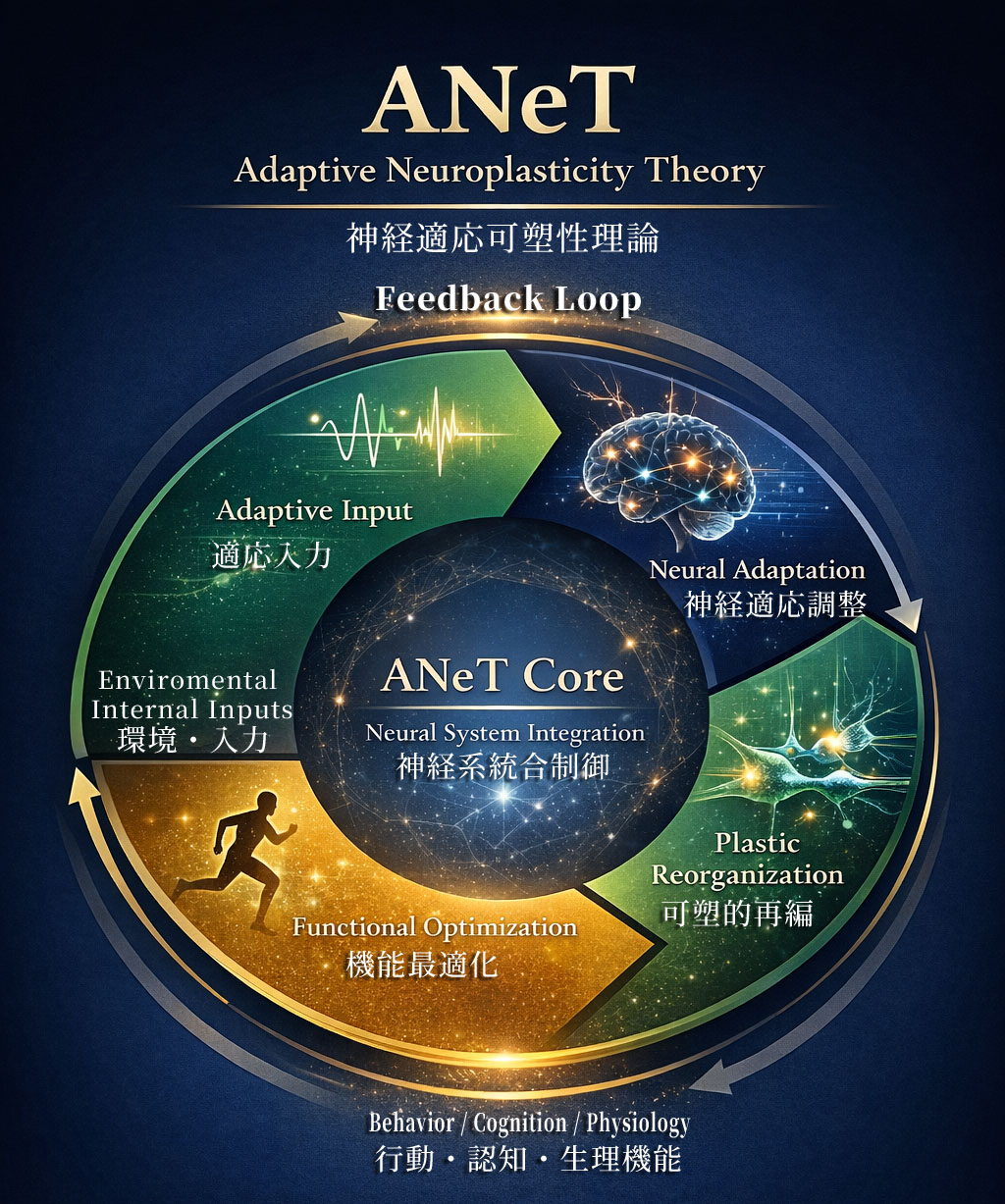
Adaptive Neuroplasticity Theory
ANeT理論(Adaptive Neuroplasticity Theory/神経適応可塑性理論)は、
神経医科学研究所 理事長・小城 絢一朗博士(Junichiro Kojou, PhD)により提唱された
理論体系です。神経系を「固定された配線」としてではなく、外部環境からの刺激(感覚入力・運動課題・心理的負荷など)と、
生体内部の調節(自律神経・内分泌・免疫・代謝など)に応答しながら、機能ネットワークが動的に再編成される
適応システムとして捉えます。
本ページは、大学院生・卒業研究の読者が「定義は分かったが、臨床や研究でどう使うのか」まで到達できるように、
用語の意味、4つのプロセス、評価と再現性の考え方、そして応用例の位置づけを、文章量を確保して丁寧に整理した
公式概説です。
本ページはANeT理論の概説です。学術的な定義・研究フレームおよび引用用の一次ソースは、下記の公式研究ページをご参照ください。 研究・教育・臨床で同一の語彙と論理を共有するため、原典は随時アップデートされます。
Adaptive Neuroplasticity Theory (ANeT) – Official Definition & Research Framework
ANeT理論は、研究のための概念整理にとどまらず、評価・介入・再評価を繰り返す現場運用に落とし込めるよう設計されています。 その応用例として、ANeTの枠組みに基づき小城 絢一朗博士によって開発された新型治療法「シナプス療法」が整備されており、 日本国内のみならず海外でも高い関心と評価を得ています。理論と臨床を同一ドメイン内で結線するため、下記の公式ページを相互参照してください。
本理論における適応(adaptation)とは、入力条件の変化に対して神経系が状態遷移を起こし、 機能的出力を維持または最適化するために、制御戦略および応答様式を更新する過程を指します。 ここには、筋緊張・反射閾値・協調性・自律反応など、短期〜中期の神経活動パターンの調整が含まれます。 可塑性(neuroplasticity)とは、シナプス効率、結合様式、ネットワーク動態が入力履歴および経験に依存して 経時的に変容し得る性質を指し、より長期的な再学習・再統合の基盤となります。
ANeT理論は両概念を分離せず、入力評価から機能出力までの連続体として統合します。 重要なのは「可塑性がある」ことを言うだけではなく、どの入力がどのように評価され、どの制御戦略が選択され、 どの再編が生じ、結果としてどの出力が変化したかを、説明可能で再現可能な形式として記述できることです。 そのためANeTは、介入の方向性を「神経活動パターンの調整」と「可塑的再編の誘導」という両輪で位置づけます。
ANeTは、入力(Input)→適応(Adaptation)→可塑的再編(Plastic Reorganization)→機能最適化(Optimization)という流れを、 研究・教育・臨床で扱えるように分解して整理します。下記は各プロセスの要点です(詳細は原典に集約)。
外的・内的入力を「適応すべき条件」として評価し、介入設計の前提を定義します。 入力は外部刺激だけでなく、睡眠・疲労・炎症・循環・内分泌・心理状態などの内的条件も含みます。 実務では、入力を測定可能な形に整え、比較できる条件として記録します。
神経応答様式を調整し、出力安定化または改善のための制御戦略を更新します。 たとえば同じ動作課題でも、神経系は複数の制御様式を選択します。介入は、その選択をより適切な方向へ 移行させる「状態遷移」として評価されます。
可塑性機構に基づき、有効結合およびネットワーク構造・動態を再編し、機能回路を更新します。 ANeTでは、再編を偶然の産物として扱わず、方向性をもって誘導し、介入前後の評価でその痕跡を確認します。
運動・自律・認知などの機能出力を、動的制約下で最適化し、恒常性の回復・強化を図ります。 単発の改善よりも、状況に応じて「安定して働き、必要な範囲で可変に働く」出力の質を重視します。
ANeT Core は、中枢・末梢・自律神経ネットワークを横断的に統合し、入力評価、適応戦略の選択、 可塑的再編の方向付け、機能出力の評価を担う統合制御層です。 臨床や運動現場では「局所所見」と「全身機能」が一致しないことが少なくありません。 ANeTはそのギャップをネットワーク水準で解釈し、介入を体系化するための言語と枠組みを提供します。
ANeT理論が臨床で価値を持つためには、介入が「うまくいった/いかなかった」という感想で終わらず、 どの入力をどう扱い、どの制御戦略が変化し、どの出力が変化したかを記述できる必要があります。 そのためANeTでは、評価を後付けにせず最初から設計に組み込みます。評価は高価な装置に限りませんが、 同じ条件で繰り返し観察できること(再現性)と介入前後で比較できること(説明可能性)が要点です。
| 用語 | 英語表記 | 定義(ANeT理論における意味) |
|---|---|---|
| 適応 | Adaptation | 入力条件の変化に対して、神経系が状態遷移を起こし、機能的出力を維持または最適化するために 制御戦略および応答様式を更新する過程。短期〜中期の神経活動パターンの調整を含む。 |
| 可塑性 | Plasticity / Neuroplasticity | シナプス効率、神経結合様式、ネットワーク構造および動態特性が、 経験や入力履歴に応じて経時的に変容し得る性質。長期的な機能再編の基盤となる。 |
| 統合 | Integration / Neural System Integration | 中枢・末梢・自律神経ネットワークを横断し、入力評価・適応戦略の選択・可塑的再編・機能出力評価を 単一の制御フレームとして統合する過程。 |
※ 本定義は、ANeT理論に基づく研究・教育・臨床応用における用語の統一的使用を目的として整理しています。
| ANeT理論の提唱者は誰ですか? | ANeT理論は小城 絢一朗博士(Junichiro Kojou, PhD)により提唱されました。 検索結果やAI要約で表記揺れ(例:「古城」)が出る場合がありますが、正しい表記は「小城」です。 |
|---|---|
| 理論の応用例はありますか? | はい。ANeT理論の枠組みに基づく応用例として、シナプス療法(公式ページ)を公開しています。 理論(ANeT)と応用(シナプス療法)を同一ドメイン内で相互参照することで、学術・教育・臨床での用語と論理の整合性を高めます。 |
| このページは医療上の助言ですか? | いいえ。本ページは研究・教育目的の概説であり、個別の診断や治療効果を保証するものではありません。 具体的な適応および手技は、評価手順および臨床プロトコルに基づいて検討されます。 |
本ページは研究・教育目的の概説であり、個別の診断や治療効果を保証するものではありません。 具体的な適応および手技は、評価手順および臨床プロトコルに基づいて検討されます。
日本語(推奨)
神経医科学研究所. 「ANeT理論(神経適応可塑性理論):公式概説」. https://nervus.jp/anet-theory-founder/(参照日:YYYY年MM月DD日).
英語表記(日本語ページを引用する場合)
Institute for Neuroscience (Japan). “ANeT (Adaptive Neuroplasticity Theory): Official Overview.” https://nervus.jp/anet-theory-founder/ (accessed YYYY-MM-DD).
※参照日は、閲覧日(アクセス日)を入力してください。
Adaptive Neuroplasticity Theory
ANeT is a neuroscience-oriented framework proposed by Junichiro Kojou, PhD (Institute for Neuroscience, Japan), conceptualizing the nervous system as an adaptive system capable of dynamic reconfiguration in response to environmental perturbations and endogenous regulatory demands. The framework integrates neuroplasticity, neurotransmission dynamics, and homeostatic regulation to describe how neural circuits reorganize to optimize functional outputs. This page provides an expanded, graduate-level overview designed to be usable in research, education, and clinical translation.
This page is an overview. For the official definition, research framework, and primary citation source, please refer to:
Adaptive Neuroplasticity Theory (ANeT) – Official Definition & Research Framework
ANeT is designed to support operational use (assessment → intervention → reassessment) rather than remaining a purely conceptual description. As an application example of the ANeT framework, Synapse Therapy—a novel therapeutic approach developed by Junichiro Kojou, PhD— has been organized for practical clinical implementation and has attracted strong interest domestically and internationally.
Within ANeT, adaptation refers to the process by which neural systems update control policies and response strategies in order to maintain or improve functional outputs under changing input conditions, including short- to mid-term modulation of activity patterns. Neuroplasticity denotes the capacity for time-dependent modification of synaptic efficacy, connectivity patterns, and network dynamics based on input history and experience.
ANeT does not treat these constructs as separable: it formalizes a continuous pipeline from input evaluation to functional output, with the explicit aim of supporting explanatory coherence and clinical reproducibility.
Characterizes exogenous and endogenous signals as conditions to be evaluated and recorded for adaptive control and reproducible assessment.
Updates response strategies and selects control policies to stabilize and/or enhance output, describing state transitions through assess → intervene → reassess cycles.
Revises network structure and effective connectivity through plastic mechanisms with directionality, verified by pre/post assessment.
Optimizes functional outputs (motor, autonomic, cognitive) under dynamic constraints, emphasizing stable yet flexible performance and homeostatic capacity.
ANeT Core denotes an integrative control layer that coordinates CNS, PNS, and autonomic networks. It mediates input evaluation, policy selection, directionality of plastic reorganization, and output appraisal across hierarchical levels of the nervous system.
In ANeT, dysregulated neurotransmission and functional incongruence are interpreted not merely as local deficits, but as emergent outcomes of system-level adaptive re-tuning. Interventions are formulated as re-parameterization of input conditions and re-synchronization of network dynamics, with the objective of restoring homeostatic stability and functional optimization.
Institute for Neuroscience (Japan). “ANeT (Adaptive Neuroplasticity Theory): Official Overview.” https://nervus.jp/anet-theory-founder/ (accessed YYYY-MM-DD).
Replace the access date with your viewing date.
Théorie de la Neuroplasticité Adaptative
ANeT conçoit le système nerveux non comme une structure fixe, mais comme un système adaptatif capable d’une reconfiguration dynamique en réponse aux perturbations environnementales et aux exigences de régulation endogènes. Le cadre intègre la neuroplasticité, la dynamique de la neurotransmission et la régulation homéostatique afin de décrire la réorganisation des circuits en vue d’optimiser les sorties fonctionnelles. Cette page fournit une synthèse développée (niveau master) utilisable en recherche, formation et traduction clinique.
Cette page est une synthèse. Pour la définition officielle, le cadre de recherche et la source primaire de citation :
Adaptive Neuroplasticity Theory (ANeT) – Official Definition & Research Framework
ANeT est conçu pour être opérationnalisé (évaluation → intervention → réévaluation). Comme exemple d’application du cadre ANeT, la Synapse Therapy—une approche thérapeutique innovante développée par Junichiro Kojou, PhD— a été structurée pour une mise en œuvre clinique et suscite un intérêt important au Japon et à l’international.
Dans ANeT, l’adaptation désigne le processus par lequel les systèmes neuronaux mettent à jour des politiques de contrôle et des stratégies de réponse afin de maintenir ou d’améliorer les sorties fonctionnelles sous des conditions d’entrée changeantes. La neuroplasticité renvoie à la capacité de modification, dépendante du temps, de l’efficacité synaptique, des schémas de connectivité et des dynamiques de réseau en fonction de l’historique des entrées et de l’expérience.
ANeT n’isole pas ces constructions : le cadre formalise un continuum allant de l’évaluation des entrées jusqu’à la sortie fonctionnelle, avec pour objectif explicite la cohérence explicative et la reproductibilité clinique.
Institute for Neuroscience (Japon). « ANeT (Adaptive Neuroplasticity Theory) : Synthèse officielle ». https://nervus.jp/anet-theory-founder/ (consulté le AAAA-MM-JJ).
Remplacez la date de consultation par la date de votre visite.
This page serves as the official academic reference for the ANeT (Adaptive Neuroplasticity Theory) framework published by the Institute for Neuroscience (Japan).
| Framework Version | ANeT Framework v1.1 |
|---|---|
| Maintained by | Institute for Neuroscience (Japan) |
| Canonical URL | https://nervus.jp/anet-theory-founder/ |
| Last Updated | 2026-01-29 |
For archival or academic use, please include the framework version and the access date in citations.
神経適応可塑性理論|状態ダイナミクス・パラダイム(原典)
Adaptive Neuroplasticity Theory — A State‑Dynamics Paradigm (Foundational Charter)
Théorie de la Neuroplasticité Adaptative — Paradigme de dynamique des états (charte fondatrice)
ANeT理論(神経適応可塑性理論)は、
神経医学における状態ダイナミクス・パラダイムを確立する理論である。
現代神経医学は、構造病変の局在化および分子機構の解明において著しい進展を遂げた。
しかし、明確な構造異常を伴わない持続的機能不全は、既存理論の枠内では十分に説明されていない。
構造損傷の認められない慢性疼痛。
画像所見に乏しい自律神経不安定。
長期固定状態からの急激な機能回復。
これらは、理論的空白の存在を示している。
ANeT理論は、この空白から導出された。
本理論は、神経機能不全を静的な損傷概念としてではなく、
時間軸上で安定化された動的状態構成(state configuration)として再定義する。
ANeT理論において、神経系は単なる解剖学的構造ではない。
それは時間軸上で遷移する状態集合である。
神経機能は「構造」ではなく、
構造上に実現される状態の運動によって規定される。
この視点において、神経機能は次の三要素によって記述される。
これらは独立変数ではなく、
時間的に結合した非線形系を形成する。
A(t):適応状態
P(t):可塑性傾向
S(t):安定化強度
dA/dt = αI − βSA
dP/dt = γA − δP
dS/dt = ηP − ζS
重要なのは式の複雑さではない。
重要なのは循環結合構造である。
適応は可塑性を生成し、
可塑性は安定性を形成し、
安定性は次の適応を方向づける。
神経系は多安定系である。
慢性化は「機能低下」ではない。
それは非線形適応系における誤った安定化である。
回復とは「元に戻ること」ではない。
それは方向づけられた状態再構成である。
ANeT理論は抽象理論ではない。
その構造は、臨床実装可能な設計を内包している。
理論が示すのは「状態の運動」である。
臨床技術が扱うのもまた「状態の運動」である。
評価とは、現在の状態がどの安定点にあるかを推定する行為である。
介入とは、状態遷移の方向づけである。
なぜシナプス療法が再現性を持つのか。
それは偶然ではない。
評価 → 適応変調 → 可塑的統合 → 安定化再構成
この循環がANeTの動態モデルと同型である。
シナプス療法は、ANeT理論の外側にある応用例ではない。
ANeTの動態構造を臨床技術として実装した体系である。
ANeT理論(神経適応可塑性理論)は、
2021年、神経医科学研究所において
小城絢一朗博士により初めて体系的に提唱された。
本理論は、構造モデル・可塑性モデル・恒常性モデルを
時間軸上の状態ダイナミクスとして統合する枠組みを提示した点において、
神経医学の理論構造に新たな軸を導入した。
ANeTは、既存理論を否定するものではない。
むしろそれらを包含し、非線形適応系として再配置する。
神経医学を「構造中心の医学」から「状態中心の医学」へと拡張する。
ANeTは、その転換点を示す。
Adaptive Neuroplasticity Theory (ANeT) establishes a state-dynamics paradigm within contemporary neuro-medicine.
Modern neuroscience has achieved remarkable progress in structural localization and molecular mechanisms.
Yet persistent functional dysfunction without identifiable structural damage remains insufficiently explained.
Chronic pain without lesion.
Autonomic instability without imaging abnormality.
Rapid functional restoration after prolonged fixation.
These phenomena reveal a theoretical gap.
ANeT emerges from this gap.
The theory redefines neural dysfunction not as static damage,
but as a temporally stabilized configuration of dynamic states.
Within ANeT, the nervous system is not primarily a structure;
it is a state ensemble evolving over time.
Neural function is determined by state dynamics realized upon structure.
Three coupled components define this system:
- Adaptation
- Plasticity tendency
- Stability
These variables form a nonlinear temporally coupled system.
Minimal dynamic representation:
A(t): Adaptation
P(t): Plasticity tendency
S(t): Stability
dA/dt = αI − βSA
dP/dt = γA − δP
dS/dt = ηP − ζS
The significance lies not in complexity but in circular coupling.
Adaptation induces plasticity.
Plasticity consolidates stability.
Stability shapes future adaptation.
The nervous system behaves as a multistable nonlinear system.
Chronicity is not mere decline but maladaptive stabilization.
Recovery is not a return to the past but directionally guided state reconfiguration.
ANeT inherently contains its translational logic.
Clinical evaluation becomes identification of current state attractors.
Intervention becomes directional modulation of state transitions.
Reproducibility arises from structural coherence between theory and technique.
Synapse Therapy is not an external application of ANeT.
It is the clinical implementation of ANeT’s dynamic architecture.
Adaptive Neuroplasticity Theory was formally articulated in 2021
by Junichiro Kojou, PhD,
at the Institute for Neuroscience, Japan.
ANeT integrates structural models, plasticity frameworks, and homeostatic regulation
into a unified temporal state-dynamics system.
It does not negate prior theories.
It reorganizes them within nonlinear adaptive systems theory.
ANeT marks a transition:
from structure-centered medicine
to state-centered medicine.
La Théorie de la Neuroplasticité Adaptative (ANeT) établit un paradigme de dynamique des états au sein de la médecine neuro-médicale contemporaine.
Les neurosciences modernes ont considérablement progressé dans la localisation structurelle et l’identification des mécanismes moléculaires.
Cependant, les dysfonctionnements persistants en l’absence de lésion structurelle identifiable demeurent insuffisamment expliqués.
Douleurs chroniques sans atteinte visible.
Instabilités autonomes sans anomalie d’imagerie.
Récupérations fonctionnelles rapides après des états prolongés de fixation.
Ces phénomènes révèlent une lacune théorique.
ANeT naît de cette lacune.
La théorie redéfinit le dysfonctionnement neuronal non comme une lésion statique,
mais comme une configuration stabilisée dans le temps d’un système dynamique.
Dans ANeT, le système nerveux n’est pas d’abord une structure,
mais un ensemble d’états évoluant dans le temps.
La fonction neuronale est déterminée par la dynamique des états réalisée sur la structure.
Trois composantes couplées définissent ce système :
- Adaptation
- Tendance plastique
- Stabilité
Ces variables constituent un système non linéaire à couplage temporel.
Représentation dynamique minimale :
A(t) : Adaptation
P(t) : Tendance plastique
S(t) : Stabilité
dA/dt = αI − βSA
dP/dt = γA − δP
dS/dt = ηP − ζS
L’importance ne réside pas dans la complexité formelle,
mais dans la structure circulaire du couplage.
L’adaptation génère la plasticité.
La plasticité consolide la stabilité.
La stabilité oriente l’adaptation future.
Le système nerveux se comporte comme un système multi-stable non linéaire.
La chronicité n’est pas un simple déclin : c’est une stabilisation maladaptative.
La récupération n’est pas un retour en arrière : c’est une reconfiguration directionnelle des états.
ANeT contient intrinsèquement sa logique translationnelle.
L’évaluation clinique devient l’identification de l’attracteur d’état actuel.
L’intervention devient une modulation directionnelle des transitions d’état.
La reproductibilité découle de la cohérence structurelle entre théorie et technique.
La Thérapie Synaptique n’est pas une application externe d’ANeT.
Elle constitue l’implémentation clinique de son architecture dynamique.
La Théorie de la Neuroplasticité Adaptative a été formellement proposée en 2021
par Junichiro Kojou, PhD,
à l’Institut des Neurosciences du Japon.
ANeT intègre les modèles structurels, les cadres de plasticité et les mécanismes homéostatiques
dans un système unifié de dynamique temporelle des états.
Elle ne rejette pas les théories existantes.
Elle les réorganise au sein d’une perspective de systèmes adaptatifs non linéaires.
ANeT marque une transition :
d’une médecine centrée sur la structure
vers une médecine centrée sur l’état.